Negative Binomial Distribution

Definition: X ~ NB(r, p)

r: required number of successes

p: probability of success

The negative binomial distribution is a discrete distribution used to calculate the probability that the first successful r outcomes are achieved on the xth trial.

Example

NB(3,0.5): The probability of 3 successful outcomes over x trials, where the probability that an outcome is a success is 0.5.
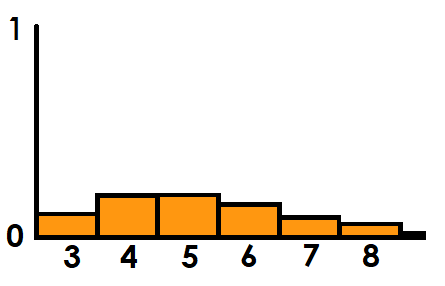
Binomial Graph

Conditions

  • The trials are independent of each other
  • There are two possible outcomes; success or failure
  • The probability of success is constant

Formulae

P(X = x) =
x-1Cr-1pr(1 - p)x-r
=
(x-1)!
(r-1)! (x - r)!
× pr(1-p)x-r
E(X) =
r
p
VAR(X) =
r(1 - p)
p2

Enter the parameters for the NegativeBinomial distribution:

Number of successes: r

Probability of success: p


This calculator does the following

  • Displays the statistics for the defined distribution
  • Calculates the probabilities for a given value of x
  • Calculates the inverse for a given probability
  • Calculates the values for a hypothesis test given the significance level: H0, H1, the critical region, probability of a type I error and the probability of a type II error given the actual parameter.
  • Calculates the values for a hypothesis test given the critical region: H0, H1, the test size, the test power for the actual parameter or the power table if no parameter is specified.
  • Displays a table of probabilities for the distribution