
Pythagorean Triples |
Pythagorean Triples
Pythagoras' Theorem
For any right-angled triangle, the square of the length of the hypotenuse is equal to the sum of the squares of the other two sides.
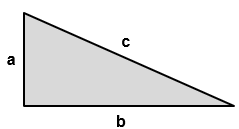
a2 + b2 = c2
Pythagorean triples
- If two of the sides of a triangle have integer values, and using Pythagoras's theorem, the resulting third side also has an integer value, then the lengths of the three sides form a Pythagorean triple
- The triple consist of three positive integers a, b and c such that a2 + b2 = c2
Examples
(3,4,5) | 32 + 42 = 9 + 16 = 25, 52 = 25 |
(5,12,13) | 52 + 122 = 25 + 144 = 169, 132 = 169 |
(6,8,10) | 62 + 82 = 36 + 64 = 100, 102 = 100 |
Primitive Pythagorean triples
A primitive triple is one for which the greatest common divisor is one. For example (3,4,5) is a primitive triple but (6,8,10) is not.
There are different methods of generating primitive triples. For example each odd number can generate a unique triple with the other two numbers forming a pair that differs by one in value.
As there are infinitely many odd numbers then there are infinitely many primitive Pythagorean triples
Generating a primitive triple from a prime number
Method
- Select any odd number, a
- Let b = (a2 - 1)/2
- Let c = (a2 + 1)/2
- a2 + b2 = a2 + ((a2 - 1)/2)2
= ((4a2 + a4 - 2a2 + 1)/4)
= ((a4 + 2a2 + 1)/4)
= ((a2 + 1)/2)2
= c2 - a, b = (a2-1)/2 and c = (a2+1)/2 form a primitive triple
- b and c form a pair with c = b + 1
- As b and c differ by one, then they cannot share a common factor, so the triple is primitive
Example
- Let a = 7
- Let b = (72 - 1)/2 = 24
- Let c = (72 + 1)/2 = 25
- 72 + 242 = 252
- (7, 24, 25) form a Pythagorean triple